
Scarcity Mindset vs. Abundance Mindset

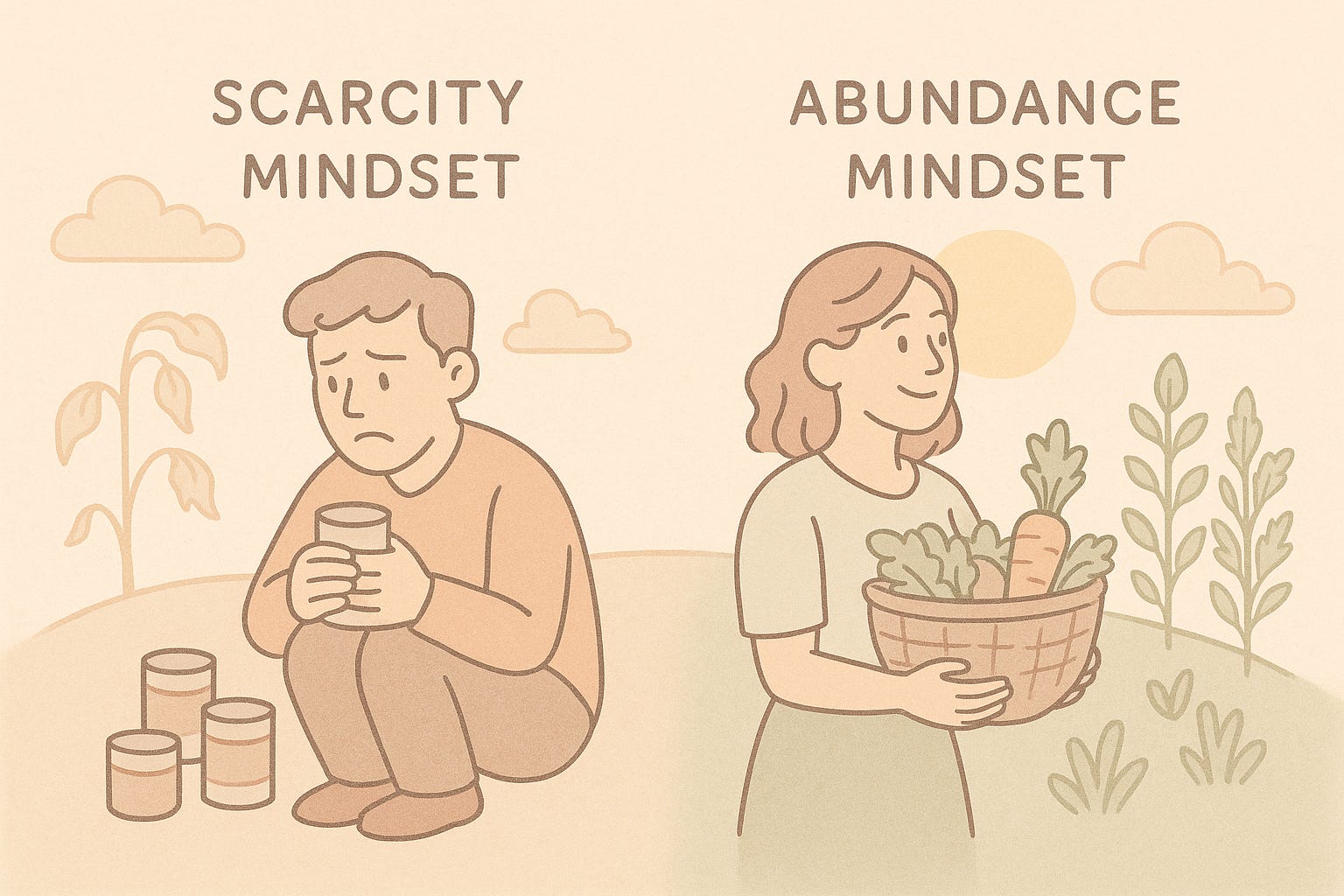
Imagine two neighbors, Alex and Maya.
Alex hoards canned beans, counts every coin, and worries that if he shares, there won’t be enough left. Maya, on the other hand, plants a garden, shares vegetables with her friends, and somehow always ends up with more than she started with.
The difference? It’s not luck—it’s mindset.
Scarcity Mindset 🥀
Psychologists describe the scarcity mindset as a mental trap where we focus on what we don’t have. When resources—whether time, money, or love—feel limited, our brain zooms in on survival. Scarcity makes us risk-averse, competitive, and often stressed.
In Samkhya philosophy (India), attachment to what we lack is considered a form of bondage. When we cling to “not enough,” we reinforce our suffering.
The Charvakas (ancient Indian materialists) would say scarcity leads to living anxiously in fear of tomorrow instead of enjoying today.
In modern psychology, scarcity reduces “mental bandwidth.” Studies show that when we fixate on financial scarcity, we literally perform worse on IQ tests because our brain is overloaded with worry.
Scarcity whispers: “There’s not enough, and if you don’t grab it now, you’ll lose.”
Abundance Mindset 🌱
The abundance mindset is the opposite—it’s the belief that opportunities, wealth, and love are renewable. People with this mindset tend to share, collaborate, and take bold risks because they don’t fear loss in the same way.
Stoicism (Greece) teaches that true abundance comes not from external possessions but from inner freedom. “He who is not content with what he has would not be content with what he would like to have,” wrote Epicurus.
Taoism (China) views abundance as flowing like water—effortless, replenishing, and everywhere if we align with nature’s rhythm.
Ubuntu (Africa) says: “I am because we are.” Abundance is collective—when I help you grow, I grow too.
Zen Buddhism (Japan) celebrates wabi-sabi—the beauty of imperfection and simplicity. Even an empty tea bowl can feel abundant when we see it with fresh eyes.
Abundance whispers: “There’s always more. Sharing multiplies.”
The Fun Story: Two Wolves 🐺
A Native American story tells of two wolves living inside us—one is fear (scarcity), the other is love (abundance). The child asks, “Which wolf wins?”
The elder smiles: “The one you feed.”
Alex feeds fear, hoarding his beans. Maya feeds love, and her garden flourishes.
How to Shift from Scarcity to Abundance 🚀
Practice Gratitude – Each night, list 3 things you already have. Gratitude flips your brain into abundance mode.
Share Something Small – Give time, money, or knowledge. Notice how sharing creates connection instead of loss.
Reframe Problems as Opportunities – Instead of “I don’t have enough time,” try “How can I use this time wisely?”
Learn from Nature – A tree doesn’t hoard sunlight; it grows taller to catch more and still shares shade.
Surround Yourself with Abundant Thinkers – Scarcity is contagious, but so is abundance.
Closing Thought 🌟
Scarcity is like living in a dark cave, always afraid the torch will go out. Abundance is stepping outside and realizing the sun has been shining all along.
So, the next time your mind says “There isn’t enough,” pause. Remember Alex’s beans and Maya’s garden. Then ask yourself: Which wolf will I feed today?